Iceland Trip Part 9 - Parts Revisited
The weather around Egilssta∂ir was entirely different than what we’d come from in and around Rey∂arfjör∂ur. Clear skies and pleasant temperatures.
Our goal was to reach the Stu∂lag Canyon campground by the end of the day, but we had a couple of potential stops to make along the way. The popular Rjúkandi Waterfall, right on the Ring Road, was just like it was our previous drive-by - packed! So we backtracked a ways to wander around Torfhúsin Hjar∂arhaga, an old farm that still had some of its turf house barns and a turf work shop.
It was interesting to see where farmers would keep their cattle in the cold winter months, and how they could survive under the inevitably harsh winter conditions in northern Iceland (yeah, we were in the north already).
As we approached Stu∂lagil Canyon, we stopped by the cafe we’d eaten at on our previous pas-by, only to find it had closed for the winter. An increasingly common thing we found on our travels. So we drove to the campground and set up camp. By now, the skies had started to cloud up and the winds that we’d left the previous days had finally made their way up north. Still, Ann and I wanted to scout the canyon from the west side in anticipation of going over to the east side, hiking in and photographing it the next morning.
Unfortunately, the water was still the silty brown it had been nearly two months earlier, not the beautiful glacial blue you can see in some photographs.
And, to be honest, I didn’t find the landscape to be nearly as interesting as I’d thought it would be. Even with being able to hike down to a lower elevation for photographs from the other side, I was no longer convinced it was a place I ‘had’ to photograph.
Ann and I discussed it that night and decided to skip the morning hike and head to other areas where we knew we wanted to photograph again.
So the next morning we headed back to the Ring Road from Stu∂lagil (no F-road this time due to the conditions), and continued our journey across the Martian-like landscape of northern Iceland.
Our ultimate destination was the Lake Myvatn area and our first stop was the Krafla Crater, where this time there was space in the parking lot for us. There are some advantages to traveling in the off-season.
As we drove back down the mountain, past the geothermal plant and near the famous hot spring shower, we pulled over to photograph the landscape in beautiful fall transition.
The colors were simply fantastic, particularly when juxtaposed against the geothermal soils.
Our next stop was the Dimmuborgir lava field. This time we took our big cameras with us. The trees had already started to turn, and some had already lost leaves to the several storms that had recently hit Iceland. Still, the lava formation landscapes were visually captivating and the different colored trees presented a very stark contrast to the previous all-green vegetation we’d seen the first time we were there.
The changed season certainly makes for a more interesting view from the platform near the visitor’s center.
We wound up camping in the same campground in the Lake Myvatn area, again because the different campground we’d decided to try (because it was right next to the lake) had closed for the season.
The next morning we were out early and headed towards the southernmost part of Lake Myvatn, Skútsta∂agigar, which is a series of craters formed by steam eruptions when molten lava hit underground water by the lake. Unfortunately, as we drove around the western side of the lake, we got hit by a wall of wind that seemed to come out of nowhere.
By the time we made it to Skútsta∂agigar, the wind was as bad as anything we’d seen on the south coast. Even the sheep knew to seek shelter from the wind by heading to low ground within the craters. By the time we completed our walk around the craters and back to the vehicle, we felt like we did that windy day in Vestrahorn - battered.
When we got back to the bimobil to figure out what we were going to do for the rest of the day (because photographing at Skútsta∂agigar was out of the question for the moment), we opened the weather app to find that it was now the Lake Myvatn area that had a red, high winds alert. Our plan had been to do laundry the next day, but we decided to juggle the plans a bit and do it a day early (at yet another new laundromat - this one had opened in early September, after we’d been here the last time). So we drove up and around the lake to the Lakeside Laundromat in Reykjahli∂.
The laundromat was much like a home - they asked you to leave your shoes at the door. Fortunately, they also provided slippers for guests to use.
The forecast was true to its word and the winds kept steadily blowing until the early hours of the next morning.
When we woke up to . . . pretty much silence, we figured we should head out to the Hverir geothermal area as planned. It was darned cold, and a steady but not terribly gusty wind blew, but the early morning light was lovely.
We worked as quickly as we could as the sun rapidly rose.
But then, again, clouds started rolling in from the eastern horizon. By the time we called it quits, we’d have to wait 15 minutes to get a 3-minute window of sunlight, only for darkness to settle in again. Still, it was a fine morning of photography.
Our next destination was Asbyrgi to the north. This time we drove a different route, across a flat, wide open plain that transitioned from a martian-scape to low ground cover as we dropped in elevation. And while it was cloudy, it didn’t rain, and the dense but scattered clouds meant it wasn’t a totally gloomy drive.
We again camped at the Asbyrgi campground and the next morning headed back to the pond at the end of the canyon where we’d photographed before. This time, fall added some contrasting color, even if it was obvious that we’d arrived a week or two too late for peak color.
Still, we worked with what we had and enjoyed our time photographing.
Eventually, the sun rose above the canyon wall and made good image-making at the pond impossible, so we started our journey out the canyon, stopping along the way for a couple of photographs. I was mesmerized by the coloration of the ground cover.
Which looked even more impressive as we gained elevation making our way back to the Ring Road.
It was a truly beautiful fall landscape.
It’s funny how sometimes, driving one direction on a road can be a very different experience than driving in the other direction. We’d driven these roads going east to west, twice not, but driving them west to east seemed to present an entirely different experience.
Time and time again one of us would comment how different the landscape seemed from when we’d passed by it before.
Even the moonscape areas seemed different.
Finally we arrived in Egilssta∂ir with a few days to spare. The forecast for areas south of Egilssta∂ir was bad again with rain in all the Eastfjörds, so Ann and I decided to take time to recoup. We spent several coffee and one drinks session at the campground cafe/restaurant, which had one of the more interesting interiors of the dining establishments we visited in Iceland.
As Ann and I discussed possible trips on the last couple of days in Iceland, we both realized that, to put it mildly, we were exhausted from our over two-month trip. We’d seen pretty much everything we’d wanted to in the area and, given the weather forecasts and how quickly it can change, we had no desire to press our luck wandering farther away from our departure area, only to have to quickly return. As seems to happen on most of our longer trips, we’d gotten to the point where we knew the trip was ending and we were satisfied with our experiences So we decided to head down to Sey∂isfjör∂ur and spend a couple of days there before our scheduled departure.
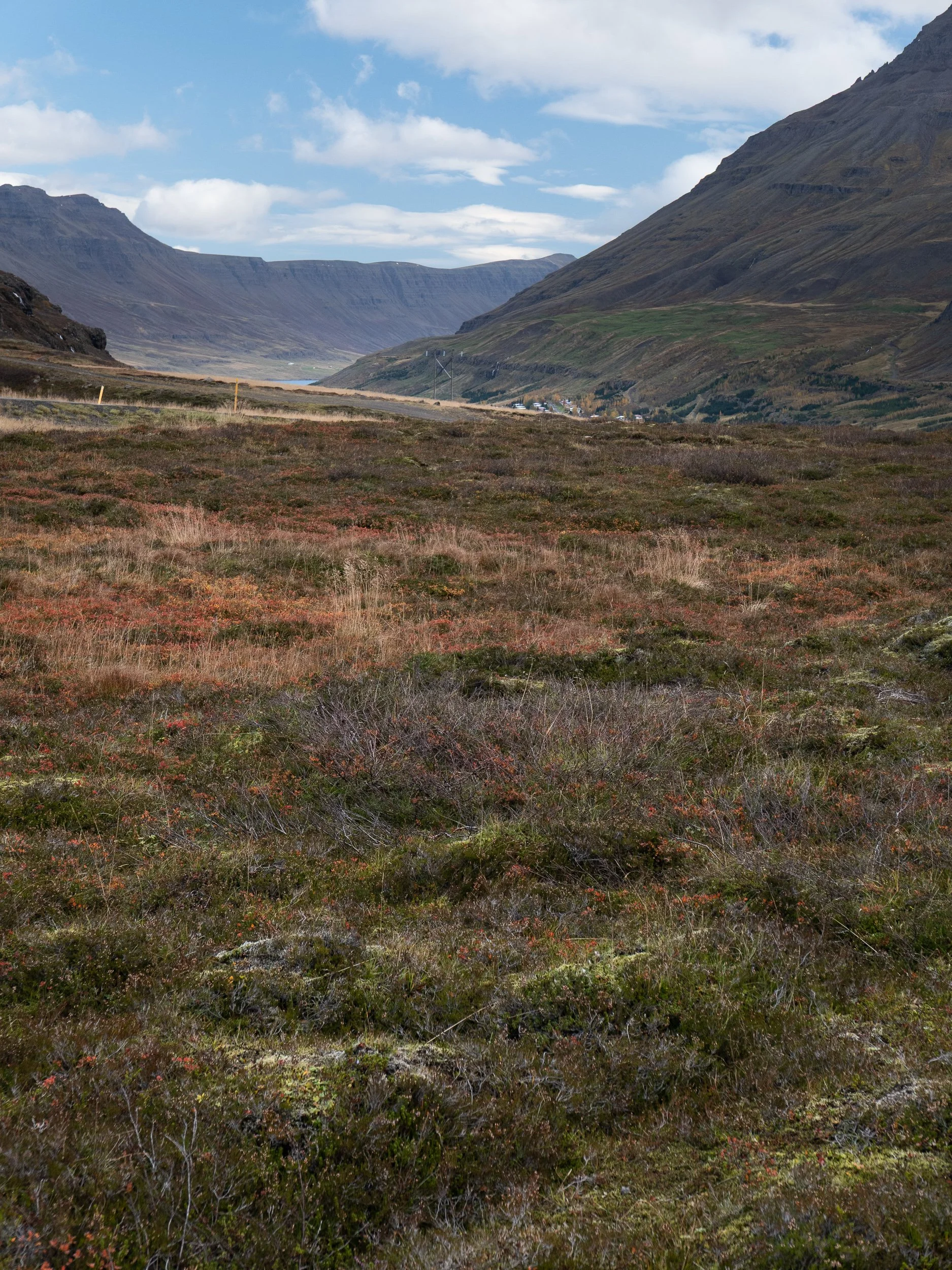
The drive to Sey∂isfjör∂ur required us to drive up a mountain and then back down into the fjörd (man the roads seemed a lot steeper on the return trip than when we first started out). On the way down, we stopped at the waterfall we bypassed our first day in Iceland during our rush to get out of the immediate area.
You could tell we were tired because we decided not to pull out the good cameras and tripods and “work the waterfall.”
Instead, we opted to enjoy the waterfall and its beautiful setting.
As well as the view down to the fjörd.
ontrary to our fears, the campground was not packed. We suspect that folks who had come to Iceland on a shorter stay had opted to maximize every single day in country. We couldn’t blame them. Still, instead of camping in the in-town campground where there were a few available spaces, we opted for the brand new “extension” area about 1/2-mile away, where we could park on the other side of the Great Wall beneath some of the avalanche barriers.
As you can see, the Great Wall is aptly named - it’s a several-story rock and wire wall (you can actually hike up and walk on top of it) designed to protect the city from snow avalanches.
The “camping” area had several parking lot style tiers that stepped up the hillside, and we were parked on the highest with a beautiful view of the Fjörd. Better yet, we had the place all to ourselves for the first two nights and saw only three more campers on the night before departure - all parked well away from each other.
All in all, not a bad placed to be parked for the last couple of days in Iceland.
The day after we arrived, the Norröna pulled into the harbor.
It was slow season now, so there was only one round trip voyage from Denmark to Iceland per week instead of two. I guess a ship has to park somewhere if it doesn’t leave almost immediately after arrival. She definitely was quite the presence for the town.
We spent our last couple of days preparing for the voyage home and wandering around Sey∂isfjör∂ur. Like pretty much every town in Iceland, it had an interesting quirkiness to it. We, unfortunately, came too late to make Ingrid’s Balcony Party.
On our second day there we took a long walk to visit a waterfall on the other side of town. Yes, that’s the Great Wall (protecting the city) just to the left of the Norröna. The ship hides where we were parked.
The fjörd around Sey∂isfjör∂ur is spectacular, just like every other fjörd we saw in Iceland.
And yeah, the waterfall destination was lovely as well.
Perhaps Sey∂isfjör∂ur’s most famous landmark is its Rainbow Street. So we had to take the obligatory tourist photograph. At least we didn’t resort do doing a selfie or make some kind of goofy pose in front of the church (like way too many people were doing). Call me old, but I don’t get it.
But Sey∂isfjö∂ur had more for the eye than just the rainbow street, so wandering around town was a pleasant way to spend the time (when it wasn’t raining).
Ultimately, I think Ann was just as glad as I was to spend a couple of days relaxing and wandering around town, not to mention eating out a couple of times and not having to think about cooking and cleaning up. We had plenty of time to download chips, clean the vehicle and get ready for the voyage home.
And then the last day arrived. Departure was in the afternoon, so we had breakfast and wandered around town that morning and, at the designated time, pulled into line to board the Norröna.
Our Grand Iceland Adventure had finally ended . . . or so we thought.