Cropping and Format Ratio Ramblings
A few days ago I was looking at some of my photographs from earlier this year, thinking about a small project I might do, when one particular image caused me to pause and to re-think the making of it. I guess that’s one of the benefits of revisiting images. Sometimes you see things anew and find qualities in images that you’d previously missed; other times you see how you can improve on the image and you learn from it. And sometimes you just see things differently and it leads you to think not just about the image, but about larger issues related to image making. This was one of those.
There are a lot of different theories/approaches to cropping photographs.
Edward Weston contended that his goal was to see an image complete and whole on the ground glass, intending for as minimal manipulation of the image after exposure as possible. He would contact print his images, so most of them are 8” x 10”. And from the prints I’ve actually seen, most have some over-matting, so they are cropped somewhat, but not really because they retain the same proportions.
Henri Cartier-Bresson, while he didn’t print his own images, insisted that his photographic prints show the film edge around them (I once hand filed my negative carriers for 35mm and square 2-1/4” to enlarge the holes so that the images would print with black film-edge around them). His thinking was that was how he saw and framed the images at the time he pressed the shutter, so that’s how they should be reproduced. He couldn’t control what editors of magazines did to the image, but when it came to prints or books - his images had to be shown full frame. Except for the fact that one of his most famous images was indeed cropped (part of the front of the lens was covered by a fence post he had the camera pressed against, and that part was usually cropped out). Or the fact that he photographed with a range-finder Leica, which has lines inside the finder that only approximate where the precise edge of the frame is. Then again, HCB was such the master that he probably knew exactly where those edges were - the compositions in his images suggest as much.
Then there is Ansel, who pretty much did what he wanted. Many, if not most, of his images seem to cover the normal framing dimensions and his attention to detail suggests that he likely wanted to get as much right as possible in-camera, but I know some images were cropped (some intentionally, some by necessity due to negative damage over the decades). But Ansel was no purist. Face it, he’s the guy who said, “Dodging and burning are steps to take care of mistakes God made in establishing tonal relationships.”
And many people argue that one should crop at will based on what the image calls for. Often the comment is, why should you restrict your vision to some random industrial cropping proportion?
There’s quite a bit of sense to that approach. But to my mind, only if in your mind you see an image that doesn’t fit the framing of the viewfinder/ground glass/LCD screen. I very rarely see an image, complete in my mind before I lift the camera. I see potential, something that excites me or interests me. It’s not until I begin to frame the image that things come together (or not). As Edward Weston put it, “I start with no preconceived idea - discovery excites me to focus - then rediscovery through the lens - final form of presentation seen on ground glass[.]” It’s that rediscovery through the lens and the framing of the subject that tells me whether, indeed, I have a photograph. Rarely do I look through the viewfinder/stare at the LCD screen/hunch over the ground glass and say to myself, “I’m going to crop this to . . . .” It either works, or it doesn’t.
As a result, personally, I’ve tended to work in full frame, regardless of what the proportions are for the camera - 4x5/8x10 (my view camera days), 2:3 (traditional 35mm film; my current sensor native ratio), 3:4 (my old micro 4/3 camera, and my beloved Contax 645), 1:1 (Hasselblad, Roleiflex, and current cropping option for my digital camera), and 5x7 (the proportions I’ve taped the back of my X-Pro 2 to show me, when it’s not showing 1:1). Yes, you read that right. I’ve taped the LCD on my camera so “full frame” is 5x7, not 2:3, which was feeling too elongated to me. Now after shooting square for awhile, 5x7 looks excessive so I may have to re-tape it to 3:4 or 4:5 (why doesn’t Fuji just give me the option to set my LCD screen to all of those formats like they do for 1:1?). Anyway, part of the craft of photography for me is to work with the frame and to play with the edges of the frame (that in itself is a whole separate blog post . . . not a bad idea).
There are practical reasons for working in full frame. It focuses the creative process at the time of image making - that need to get it right in the frame at the moment of exposure and instills a sense of discipline. It’s easy to get sloppy with photography, and sloppiness allows any number of intrusions that can weaken an image to come into play. So the discipline of framing the image carries on to other considerations in image making at the time of exposure. Full frame also maximizes the number of pixels/area of film exposed, which affords higher quality to the image if it’s enlarged at all.
So, imagine my surprise when I was looking at my images and came across one where I immediately thought, “That one should be square!” Now, given my recent foray into square image making, I guess it shouldn’t be much of a surprise that I would see square images within some of my older work. Heck, I even used to give an exercise to my class for them to take an image, and see how many different images within the image they could find. But what struck me was that this is an image that I had felt was successful at its original 5x7 vertical format.
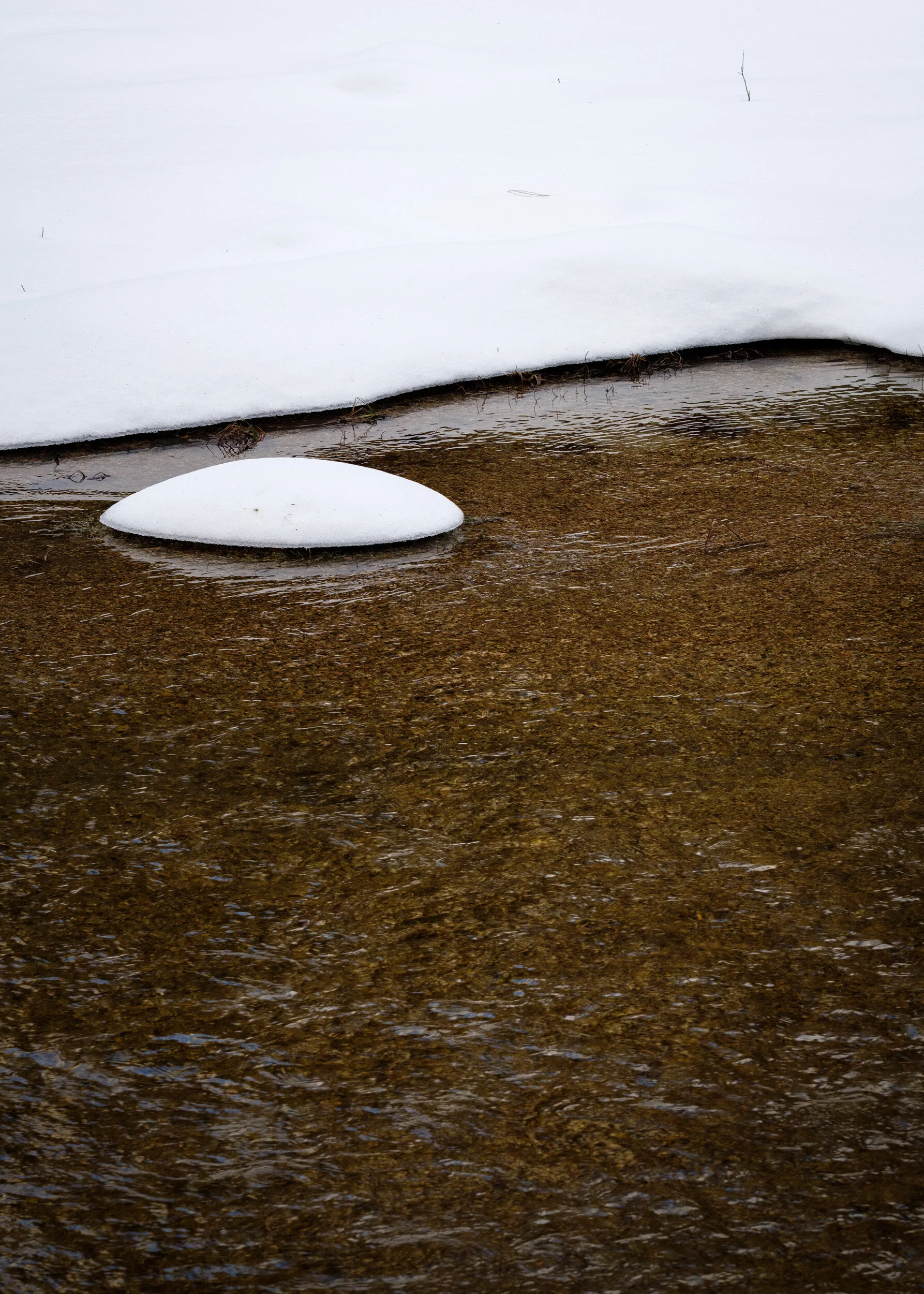
Yet it also works, perhaps somewhat better, as a square image.
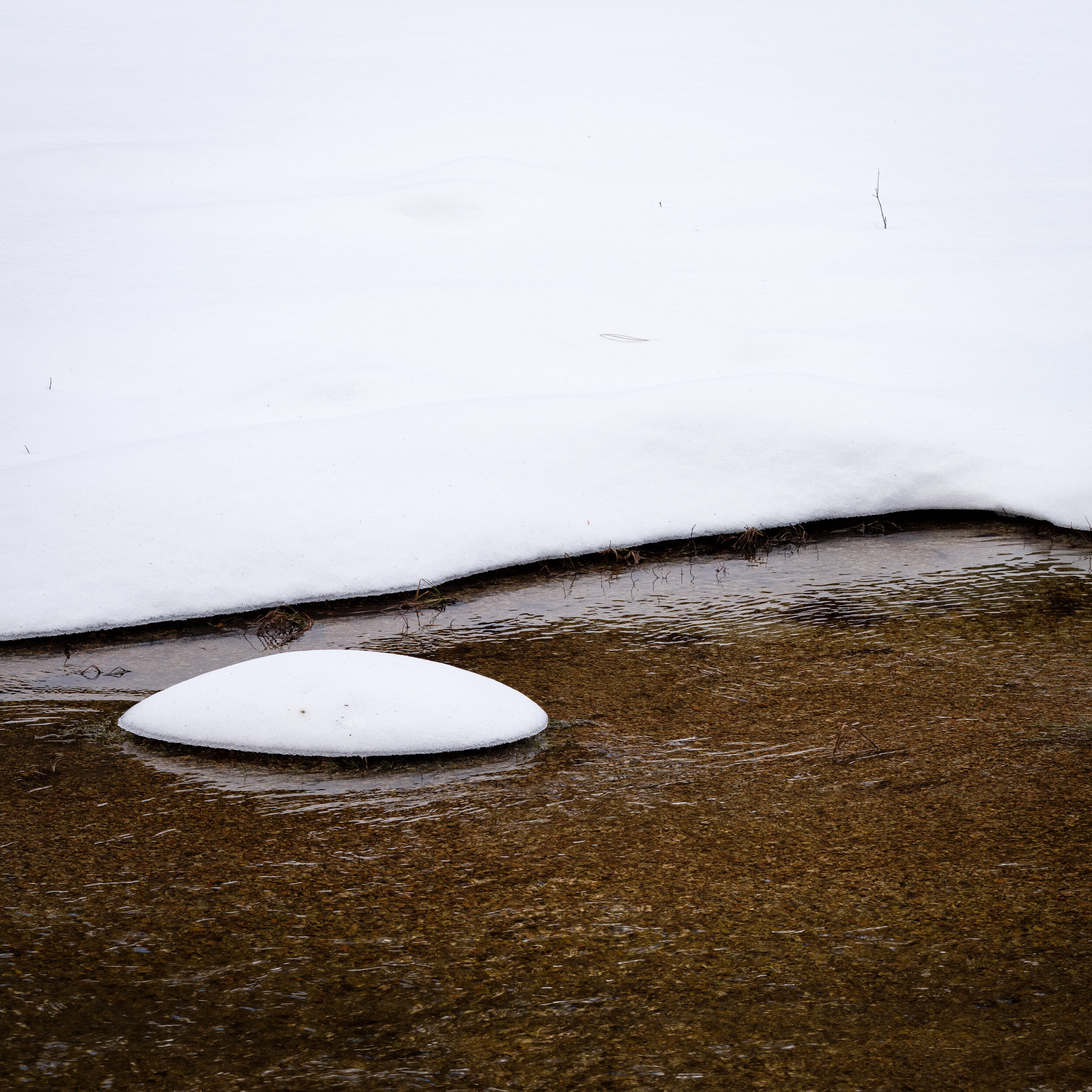
I think there’s a lot to be learned from these two images, so I’m not done looking at or thinking about them. It’s not a question of whether one is better than the other, but more of why they both fundamentally work. And why I was compelled to include the top edge of the snow (the part of the 2:3 sensor image that got cropped out of my 5x7 masking when composing and then re-framing the image in Lightroom) in the square image. And how each could be improved.
I’ve also been pondering a bit about the square images I’ve been making lately. In the few instances where I’ve reverted back to a more dimensional format while photographing I’ve wound up being quite disturbed by what I was looking at and very quickly switched back to the square format. I’ve chocked it up to the notion that I’m not yet done with exploring the square so I should just go with it until I am ready to move on. But it was strange for things to feel so wrong.
Still, I really doubt that I’m about to revisit all of my old images with the square format in mind. And even if I did, I doubt too many of those images would work as squares, given my attention the more linear framing at the time of exposure. Still, it did seem to work for this image.